Where Winds Meet: Hexi Expansion Lore Guide
The winds of change are sweeping through the world of Where Winds Meet. On March 5, 2026, the free-to-play wuxia epic launches its most ambitious content drop yet: the Hexi expansion. This isn't just another patch; it's a monumental, three-chapter journey that carries players from burning deserts to snow-capped peaks over the coming months. But to truly appreciate the grandeur of this new region, I first look to the real-life Hexi Corridor, a land so steeped in history, heroism, and heartbreak that it perfectly embodies the game's cinematic spirit.

The Historical Hexi: China's Golden Gateway
Long before it became a digital playground, the Hexi Corridor was the most important intersection on the ancient Silk Road. Its name, Hexi (河西), literally means "West of the River," referring to the Yellow River, which served as the great divide between the Chinese heartland and the vast, unknown frontiers of Central Asia. For over two millennia, this narrow passage, flanked by the Qilian Mountains and the Gobi Desert, served as the primary artery connecting empires.
It was a land defined by extremes: howling winds and dancing sand, the solemn chanting of Buddhist monks, and the thunderous hooves of cavalry. The Hexi Corridor was where China reached out to the world — and where the world reached back. It was a conduit not just for silk and spices, but for art, faith, and ideas.
The Han Dynasty: Forging the Frontier
The corridor's strategic importance first came into focus during the Han Dynasty. In 121 BC, a brilliant young general named Huo Qubing led a decisive campaign that expelled the Xiongnu nomads from the region. His victory was so complete that it allowed the Han Empire to establish the "Four Commanderies of Hexi" — Wuwei, Zhangye, Jiuquan, and Dunhuang — transforming these oasis towns into fortified military outposts and bustling trade hubs.
During this same era, Emperor Wu dispatched the explorer Zhang Qian on his legendary westward journey. Though captured and held for a decade by the Xiongnu, Zhang’s reports provided the first reliable intelligence about the Western Regions, cementing the Hexi Corridor’s place as the gateway to the unknown.
Credit: Dunhuang Foundation 美国敦煌基金会
A Crossroads of Faith and Culture
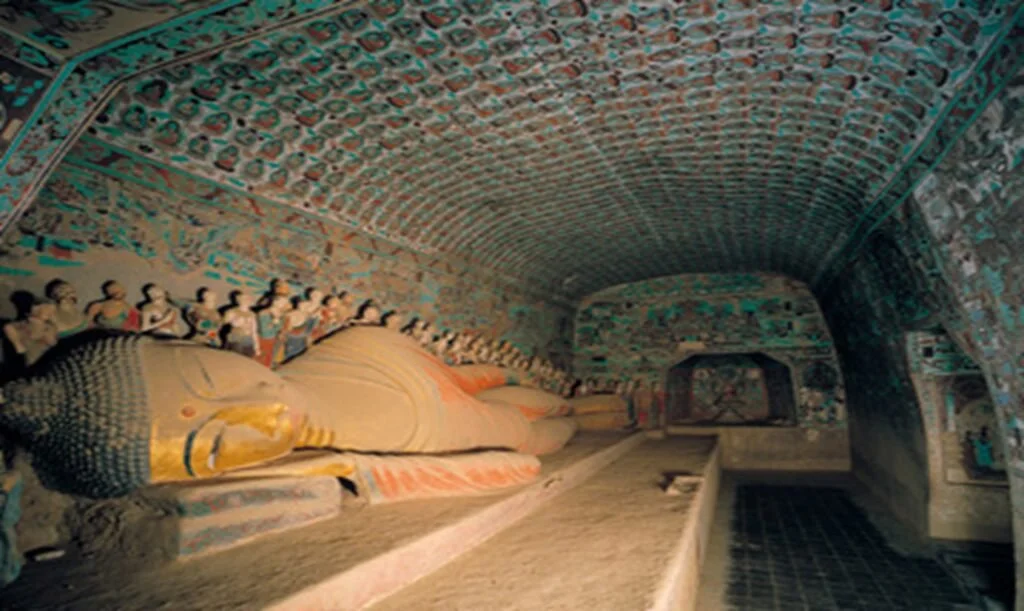
As centuries passed, the Hexi Corridor became a melting pot of cultures. It was here that Buddhism traveled eastward along the Silk Road, finding a permanent home in China. Nowhere is this legacy more visible than at Dunhuang, home to the Mogao Grottoes. Carved into desert cliffs, these "Caves of the Thousand Buddhas" are adorned with exquisite frescoes and sculptures, standing as a testament to the fusion of Indian, Central Asian, and Chinese aesthetics.
One of the most fascinating figures from this era is the monk Kumarajiva. Held in the city of Liangzhou (modern Wuwei) for nearly two decades, he used his time to master the Chinese language. Upon his release, he became history’s first great translator of Buddhist scriptures, producing works of such beauty and clarity that they shaped Chinese Buddhism for generations. The game’s second chapter, "Liangzhou," allows players to walk the same ground where this transformative work took place.
Where Winds Meet: Reimagining the Legend
Everstone Studio didn’t just copy + paste history into WWM. Instead, the developers use the rich tapestry of the Hexi Corridor as the foundation for a bold narrative approach. The expansion exists "outside of the game’s main timeline," framed as a "dream pilgrimage" that transports players back to the glorious and tumultuous Tang Dynasty. This narrative device allows players to inhabit a legendary past while maintaining the core game’s continuity.
The developers frame the three chapters as a poetic gift: a cinematic journey "from desert to ice fields to grasslands." Let’s walk through the journey that awaits.
Chapter 1: Jade Gate Pass (March 2026)
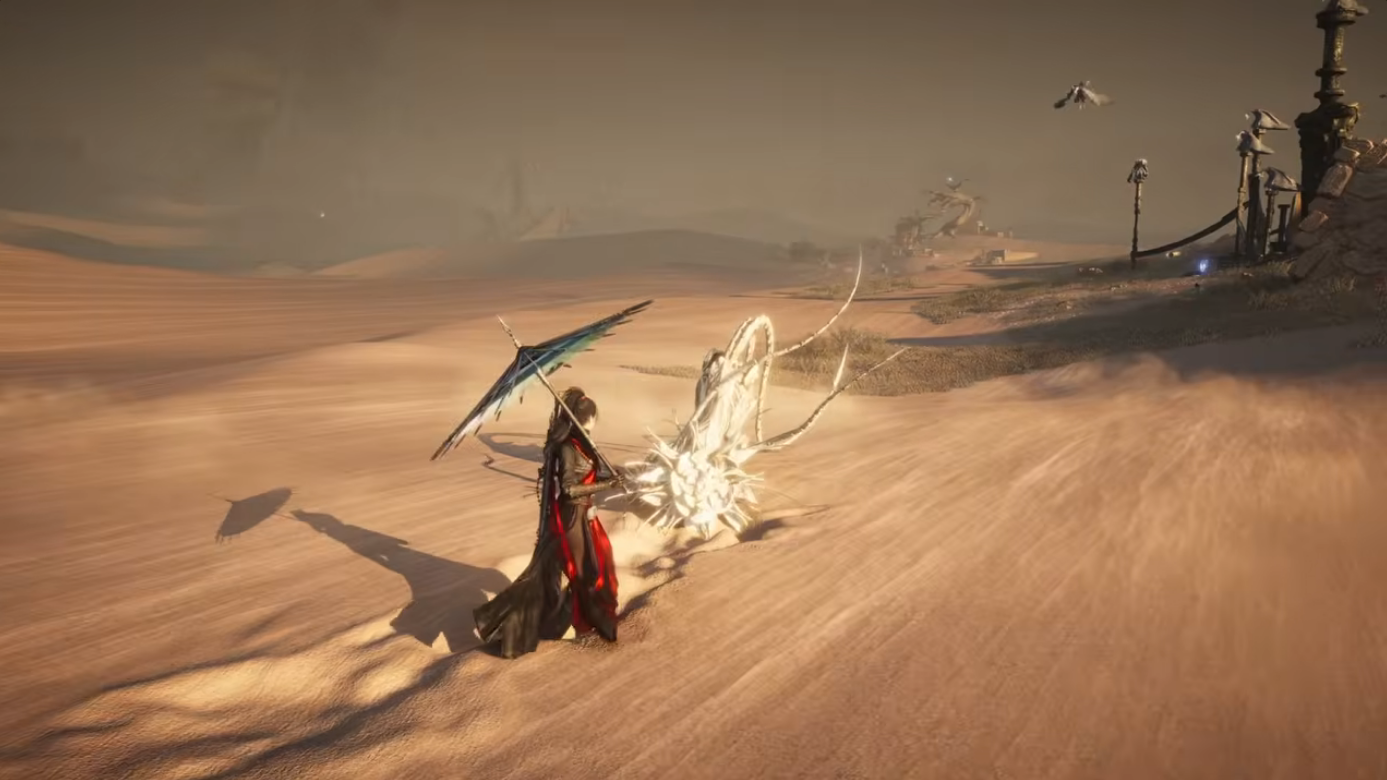
The journey begins at the Jade Gate Pass (Yumen Pass), a real historical chokepoint that marked the literal end of the Chinese empire and the beginning of the wild west. Here stretches a vast desert landscape of endless dunes and time-eroded ruins.
Players encounter two of the expansion’s 11 unique bosses.
First is Guo Xin, the "last Grand Protector of Anxi," a tragic, aging general who remains at his post. He’s a solitary guardian watching over a forgotten frontier long after the empire has moved on. The developers describe the fight as one where you defend against sweeping combos until, in a dramatic second phase, "sands swirl and time reverses," as the memory of his fallen army "jostles him back to his prime," allowing him to unleash his full power.
The second is the Wandering Ark, a colossal ghostly vessel that sails across the desert sea like a mirage. It never stays in one place, forcing players to hunt it down and strategically board it.
To survive the harsh environment, players gain two new traversal skills: Sand Race, which lets you surf the dunes, and Cosmic Reversal, a power that rewinds time to rebuild ancient, crumbling structures and solve puzzles. We also get new combat styles: the agile umbrella-style Spring Dreamscape and the sweeping rope-dart attacks of Fleeting Clouds.
Chapter 2: Liangzhou (April 2026)
As players push forward, the landscape shifts. Liangzhou represents the game’s first foray into a snow-capped mountain region. Historically known for fine wine and precious jade, Liangzhou appears in the game as a place "haunted by lingering echoes questioning why a stranger in a foreign land answers the call to return to their spiritual home."
This chapter introduces the Heng Blade weapon, a martial art centered on precision, disciplined defense, and powerful counter-strikes.
Chapter 3: Qingchuan (May 2026)
The pilgrimage concludes in the vast grasslands of Qingchuan, a "Painting Realm" where the four seasons cycle dynamically across the map. Here, the narrative threads of war, faith, and longing finally converge. The developers promise this is where "the true treasure of this adventure will be found."
Why This Matters: A Poem Carried on the Wind
The Hexi expansion is more than a new map or a list of boss fights. It represents a maturation of Where Winds Meet’s storytelling philosophy. By anchoring fantasy within the profound history of the Hexi Corridor, Everstone Studio invites players to connect with something genuine. The developers want players to "inhabit characters from history and witness the era from the perspective of ordinary people caught up in the tides of history."
When you stand before the crumbling walls of Whitecrown City, you aren’t just looking at a game asset; you stand where Han generals once garrisoned their troops. When you fight the Wandering Ark, you chase the ghost of every caravan lost in the Gobi. And when you master the new martial arts, you channel, in some small way, the spirit of the warriors, monks, and dreamers who once walked this "passage to history."
The expansion launches March 5 for PS5, PC, and mobile, with content rolling out through May. Pre-downloads are available now. So, prepare yourselves, wanderers. The wind is calling, the Jade Gate stands open, and the history of Hexi awaits.